
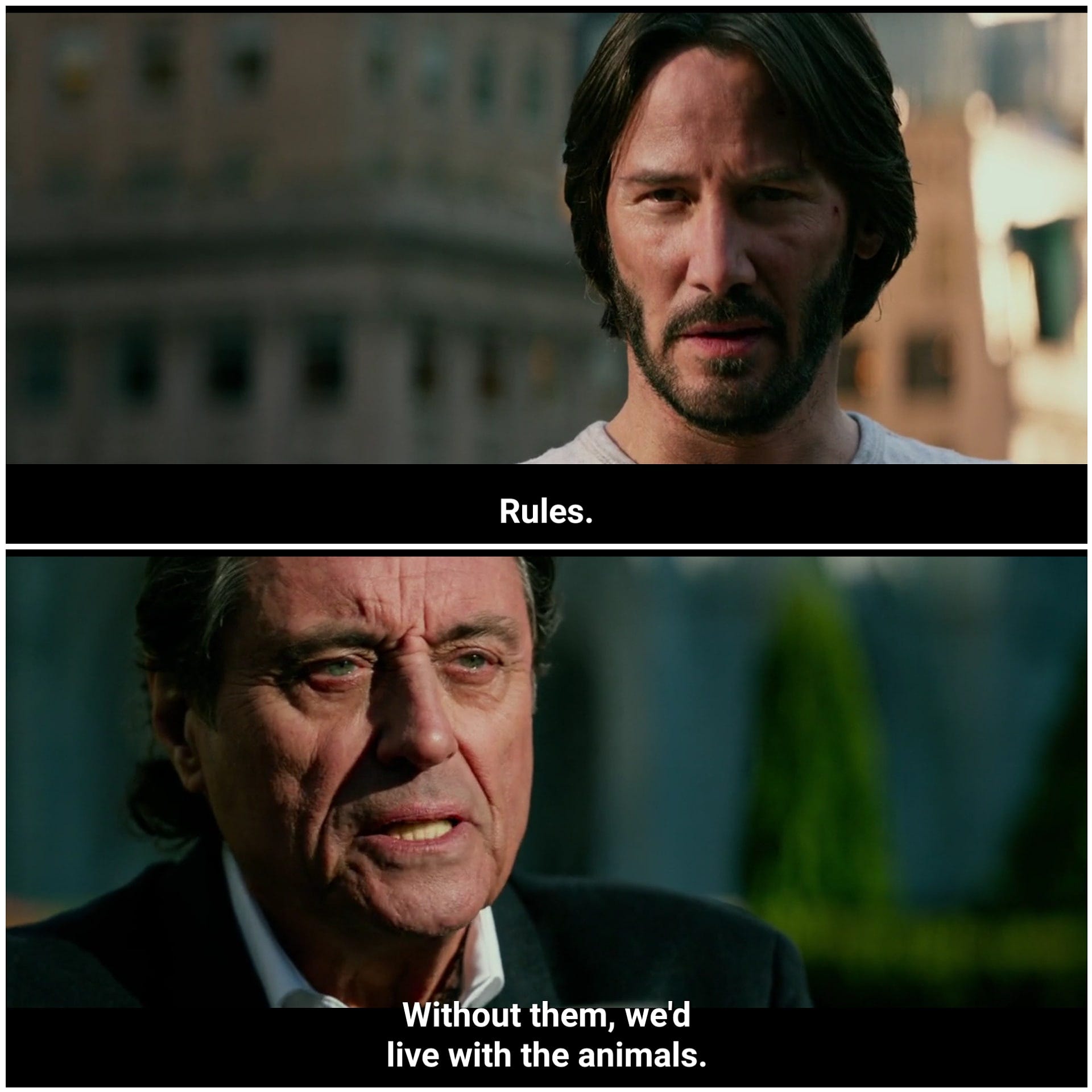
Rules...
Without them, we live with the animals.

I have two sons. Both are huge fans of bad filmmaking. Over time, a phenomenon called Forgettable Fridays has emerged in our house: we look for excellently awful movies to watch on our various streaming services.
You may find this lowbrow, and maybe it will even change your opinion of me. I can live with that, but try not to rush to judgment. I guarantee that this genre of film-making is under-rated. If you doubt this, look up Train to Busan, In the Name of the King, Godzilla X Kong, or The Great Wall. It may not be ‘Art’, capital A, but it is definitely art to make bad movies that are as good as these ones.
One Forgettable Friday, we were having a bit of a struggle session trying to find a movie. And then, there it was:

Legendary assassin John Wick (Keanu Reeves) retired from his violent career after marrying the love of his life. Her sudden death leaves John in deep mourning. When sadistic mobster Iosef Tarasov (Alfie Allen) and his thugs steal John's prized car and kill the puppy that was a last gift from his wife, John unleashes the remorseless killing machine within and seeks vengeance. Meanwhile, Iosef's father (Michael Nyqvist) -- John's former colleague -- puts a huge bounty on John's head.
Yes!!!
Little did we know that the John Wick series was dark horse awesome. All I knew was that this plot was happening right now. I slowly looked over at my son, opened up into a big, broad smile, and hit the play button.
The Rules
It opens slowly, but once things got rolling, boy did they ever roll. After the ill-advised theft of Wick’s car (amazing car) and the killing of his puppy, it was time for John, the Baba Yaga, to get to The Work.
When 12 baddies return to his house, they all die. ‘I’d like to make a dinner reservation for 12,’ says John, calmly. Absolutely, Mr. Wick.
Near the end of the first movie, Wick finds himself sitting across the table from his enemy in the Continental club, with vengeance on the menu. John knows The Rules. He knows himself.
There is a flash, the slide glides back, and then a brief silence. The Rules.
“Two rules, Jonathan — no blood on Continental grounds, and every marker must be honored…it's what separates us from the animals.”
Principles
In my last piece, I promised to lay out my Principles: the way that I think about energy, energy transition, and climate.
Something that disgusts me today is the misanthropic and Malthusian frame that some popular energy people employ. Often enough in energy dialogue, I see a disturbing lack of concern for the world’s energy poor and a pathological attachment to the future Earth, as though humans control the Earth.
I am being intentionally uncharitable here. This is where the battle lines are drawn for me.

A major weakness in energy advocacy and Oil & Gas energy advocacy is that most of it is done through a techno-economic lens. We create jobs, we pay for hospitals. And those are fine things.
What those things don’t do is use Principles to create emotional resonance.
There are some exceptions to this. Chris Wright from Liberty Energy does an incredible job communicating based on Principle. Jamie Dimon from BoA communicates well along the same lines.
Many executives in Oil & Gas are a combination of (1) afraid, (2) placative, (3) contemptuous and dismissive of criticism, (4) unskilled society-level communicators, and (5) dismissive of the need to protect their franchise. They think energy is inevitable and will always be around, but are misreading the room badly.
The entire Oil & Gas industry in the West is under attack, and the generals on the industry side are a quiet, introspective, engineering-oriented group that thinks society is made up of Philistines that just don’t understand energy, and why can’t we just stick to our core business.
With generals like that, it is hardly surprising that fighting spirit in the rank and file is low. I know lots of people who are terrified to post *anything* on social media to advocate for the industry.
The crux of the issue is that industry has been demoralized. I use this word in the sense of Communist influence operations. Today, Yuri Bezmenov’s interview should be required viewing.
“Exposure to true information does not matter anymore.
A person who is demoralized is unable to assess true information.
The facts tell nothing to him.
Even if I shower him with information, with authentic proof, with documents, with pictures. Even if I take him by force to the Soviet Union, and show him a concentration camp, he will refuse to believe it, until he is going to receive a kick in his fat bottom.
When the military boot crushes his balls, then he will understand, but not before that. That is the tragedy of the situation of demoralization.”
― Yuri Bezmenov
Bezmenov thought demoralization was irreversible. I think history teaches otherwise, but history also teaches that things change when people stand up and make them change. The world is never changed by timid, weak people.
A demoralized industry has ceded the moral high ground without mounting even a pretend defense. The time for that to end is right now.
It is time to hoist the black flag and get after it.

Prepare for Battle - The Moral High Ground
The idea of understanding Principles is important to me for far more than just theoretical reasons. In war, defeat is primarily a psychological thing. Usually, a long time before an Army is defeated physically, it has lost its fighting spirit. When that happens, defeat is usually inevitable.
Something that destroys morale is when people feel they are doing something contrary to their values. There is a non-zero number of people in Oil & Gas today that are hedging bets and wondering if their industry is evil. They look around for more ‘ethical’ jobs. I would bet a considerable amount of money that most people in industry have seen at least one (probably several) acquaintances quit an Oil & Gas job to go to work at a renewables company, or to switch roles into something they feel better about.
Before I went to Afghanistan, we had a guy named Dave Grossman in to talk to us. He is an intense person, having written books titled ‘On Killing’ and ‘On Combat.’
LCol Grossman focused us on understanding the moral case for the mission we were embarking on. We would see hard things, do hard things, very probably involving taking life. Failure to prepare morally for what war requires is expensive and can lead to moral uncertainty in combat, death, and in cases of personal moral breach, PTSD and lifelong regret.
My point here is not that people in energy are in some way soldiers.
The point is that there is a sound moral case for Oil & Gas as energy sources, but in the world we live in, we have to consciously and consistently articulate that moral case inside industry, to regular people on the street, and to elites. This is done in different ways depending on the group. But to do it, we need our moral case, our Principles, squared away.
That is what will allow us to enter the arena with confidence.
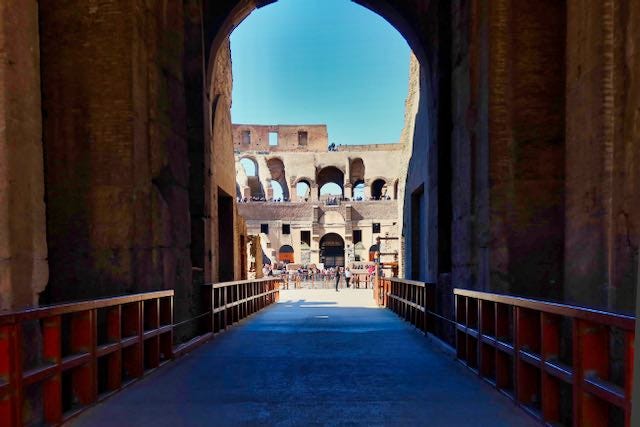
My Rules
In no particular order, here are the Principles that govern my view on energy issues, energy transition, and climate. If I miss some, I’ll come back and add them.
Abundant energy access is the basis of modern life. It must be protected.
I believe that Humans are created in the image of God. This pits me directly against a relatively small but very influential group of people that are evil, misanthropic Malthusians.
Evil, misanthropic Malthusians are different from regular people who want cleaner energy and are concerned for the environment.
Carbon is not the only variable that matters. Multivariate thinking is essential.
Science should not be treated like religion. As Feynman says ‘Science is the belief in the ignorance of experts.’ Many times in the past, key ideas have been misunderstood and corrected. Proponents of ideas that attack ‘consensus’ have been killed for their trouble. We would do well to remember that and keep some humility about just how much Science (tm) knows.
I am 100% for environmental stewardship and preservation. I believe very strongly that we should be good stewards of the planet.
Humans and energy interact in complex and chaotic systems. This means that actions should be very carefully considered and not drastically executed.
Just because something is technically possible in engineering terms does not mean it is possible to implement in the real world or that its consequences are worth the price of admission.
Most advocates genuinely care about their cause and have good intentions.
Energy Colonialism is evil. I define this as any restriction imposed by the West (including citizens, banks, institutions, policies, supranational orgs, environmental NGOs, other foreign interference, or really anything or anyone not mentioned) on the ability of developing nations to access energy to improve economies and standards of living for their people.
Allowing ends to justify means is unprincipled. Think of this in light of ESG-washing: ‘China is solving climate change so we can ignore anything bad they do.’
Market economies solve problems more efficiently than centrally planned economies. If in doubt, some reading on the Great Leap might be in order.
Honest weights and measures are important. Sophistry with numbers leads to very bad outcomes. LCOE is a notable example of this sort of thing.
Worldly realism. Understanding who is advocating for what and why is foundational to understanding energy systems. Understanding whose dollars are being spent on advocacy is important too.
Active avoidance of biases and fallacies in reasoning, especially in the case of Dunning-Kruger effect, which sees people who have massive success in one area shift towards pontificating about other areas as though they are an A-class expert. There is a picture near this entry of Bill Gates.
I am energy-source agnostic. It appalls me that nuclear is *illegal* in Australia.
Paradoxes matter and are a known part of the system. Jevon’s Paradox. The Kuznets Curve. There are no free passes to ignore paradoxes.
There is a need to separate fact from opinion. An opinion is that wind and solar are going to lower people’s energy bills. A fact is that in all cases I have seen, they increase energy bills.
Political acceptability matters. Energy poverty in the West will be politically unpopular and unelectable.
Energy security is paramount to national security. Energy security is statecraft.
Divestment and capital restrictions will result in exactly the same amount of hydrocarbons being produced, generally in higher-emission ways.
I believe in free and open energy debate. Energy producers and shippers should have the right to participate in the public discourse on energy transition, energy production, and energy policy. So should renewables advocates.
I would love to hear in the comments how you frame up your positions on energy, energy transition, and climate. If you think I should add one, let me know!
Thanks for reading!
We see it the same.
Maybe time to update this as the clear headed Chris Wright comes in as US energy secretary.
The amount of people I see weekly who tell me they love my comments on LinkedIn but they cannot publicly say so is just sad.
And yea, evil.
In 2017 I was instrumental in bringing Patrick Moore to calgary to be keynote speaker at the IEEE IPCC conference, spent an evening talking with him.
Before his speech I asked him to state clearly that everyone in the room is not a criminal, that they were doing crucial work that saves lives (ties into your principle above) and he got a standing ovation.
Was a good day.
More good days coming, the climate/insane are looking for cover everywhere.
Great post Matt. I made my peace in about 2015 as the world turned anti-oil. We saw this early as private equity LPs were early on the bandwagon. Lapping up how "disruption" by EVs and solar would push our oil and gas investments the way of Kodak and Nokia... I did my research and said... Bah humbug. Meanwhile... So many people followed the money. Into "climate funds", became ESG experts overnight. And yes lots of oil people, not just finance people (who are of course mercenary by definition). I am incredibly proud of my career. I look at people who have over-paid jobs as "product managers" for middle market consumer products and (a) wonder what on earth they actually do, and (B) think smugly that if I didn't do my job they wouldn't have jobs.
The crux is that if you believe green energy can simply replace fossil fuels with no disruption to modern life then I am 100% wrong. But I'm happy to take the under on that one .